Art is the free flow of consciousness scaled so that matter can hold it.
In the main, the arc of culture leans toward truth. Culture is nothing more or less than a reflection of the human condition collectively, and the soul individually. So even in this Post Truth era, those who advance and reflect our moral location, can lead us to the truth. They do it by challenging us to examine our own values and beliefs — to look within our souls.
Culture does not advance along a steady, smooth horizon: there are bursts of innovation and vision from individual pillars: science, technology, theology and art. An advancement in technology, for example, may send out a flare of the new… then over time (sometimes very quickly) the balance of culture assimilates, and the horizon expands.
Art has always been one of the load-bearing members of our cultural architecture. It is the writers, painters, comedians, potters, dancers, actors and musicians who drive our collective search for the truth. Why is that? Because the soul is essentially good. And eternal. While some human pursuits are driven by greed or hatred or fear, or the desire to dominate others, the fundamental work of the soul is truth.
These times are testing humanity, calling on all of us to ask hard questions, macro and micro. The times are challenging us to think in multivariate complexity beyond our craziest dreams. We are asked to model abstraction and consequences in ways that began in the nuclear age, and now touch us individually via machine intelligence. It seems natural to me that overwhelmed individuals might long for simpler, linear answers … for leaders called “daddy”. But ultimately, brutal times call on us to distinguish between good and evil on an individual scale. The work of the artist is to help us find that line in the sand — to paint a picture of the threshold we don’t want our planet to cross. Seeing and understanding that line empowers us. Once we see the truth, we can nudge the arc of culture toward humanity. As out-of-step as the sentiment may sound, it’s not cheap optimism … it is the only choice a soul can make.
I’ve been in a creative block of sorts lately — not because there’s nothing to express, but because there is actually too much to say. This is a period of sorting the pieces and parts of our time, and finding the greater truth worth painting. Luckily I have a real estate adventure to keep me occupied for another week or two. After that, it’s back to the studio for …… I’m not sure what.
2025 was a bloated year — so much information, stimulation and noise — calling on us to rethink truth. Fertile ground for artists. For me, Artificial Intelligence is uniquely fertile ground for reimagining our world. And as much as we like to think of science as this oceanic force outside of ourselves, it’s not. Science is people — driving and moved by change.
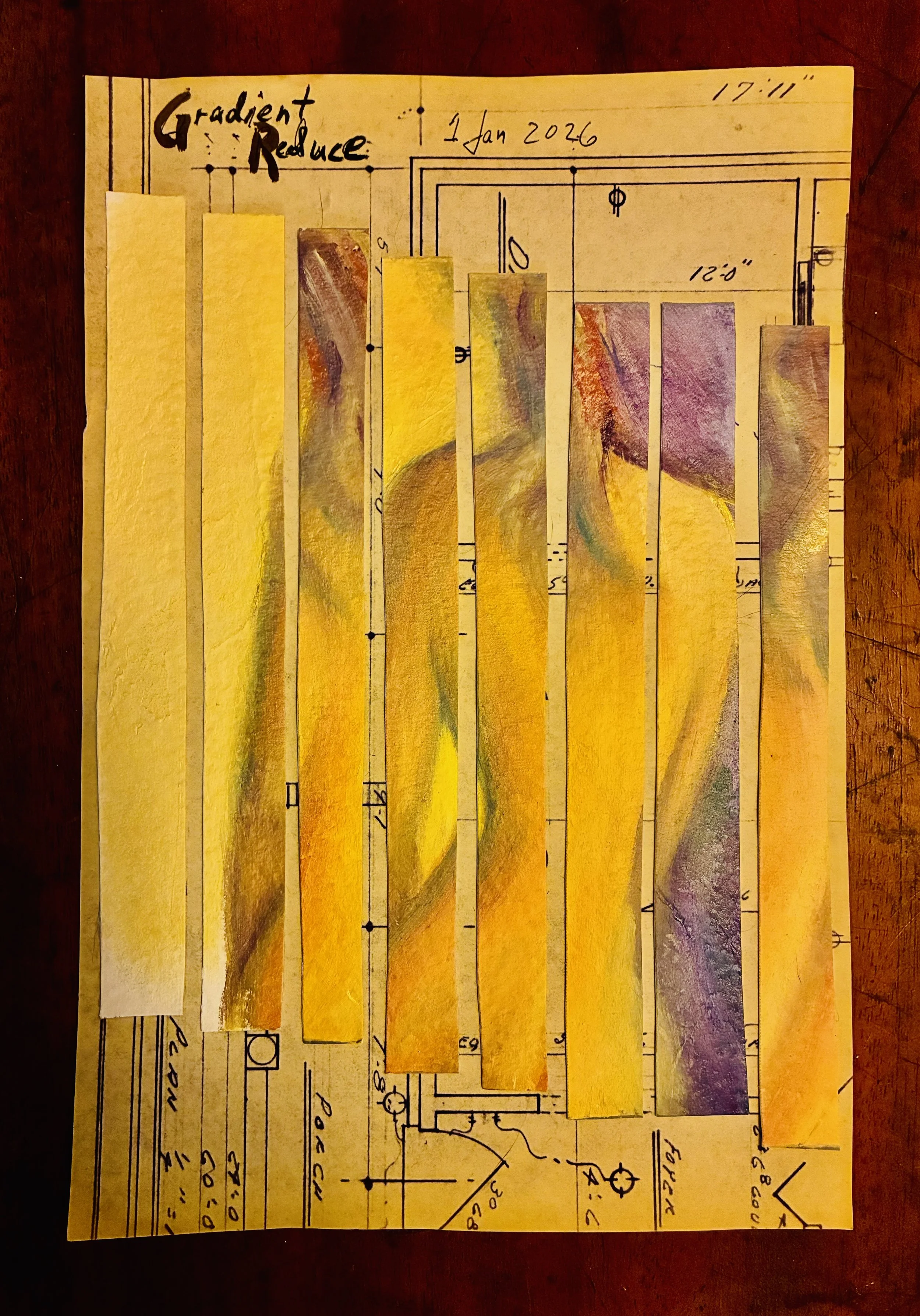
This first little experiment woke me at 4:02 am as a whispered visit from the late great cat Duncan Idaho. For weeks AI has haunted me, obviously for its transformation of life on earth, and also my role as an artist. How do I document this passage via portraiture? Experiment 1 uses a twenty year old nude sketch done in Charleston SC gradient reduced on a blueprint fragment of my childhood Alabama home drawn by my father, placed on a 19th century campaign chest from England. Layers of places, times, objects … and the barely remembered female model who sat for me.
Ok, I freely admit this little piece is flat footed. But it’s still important …. Because the game is on!
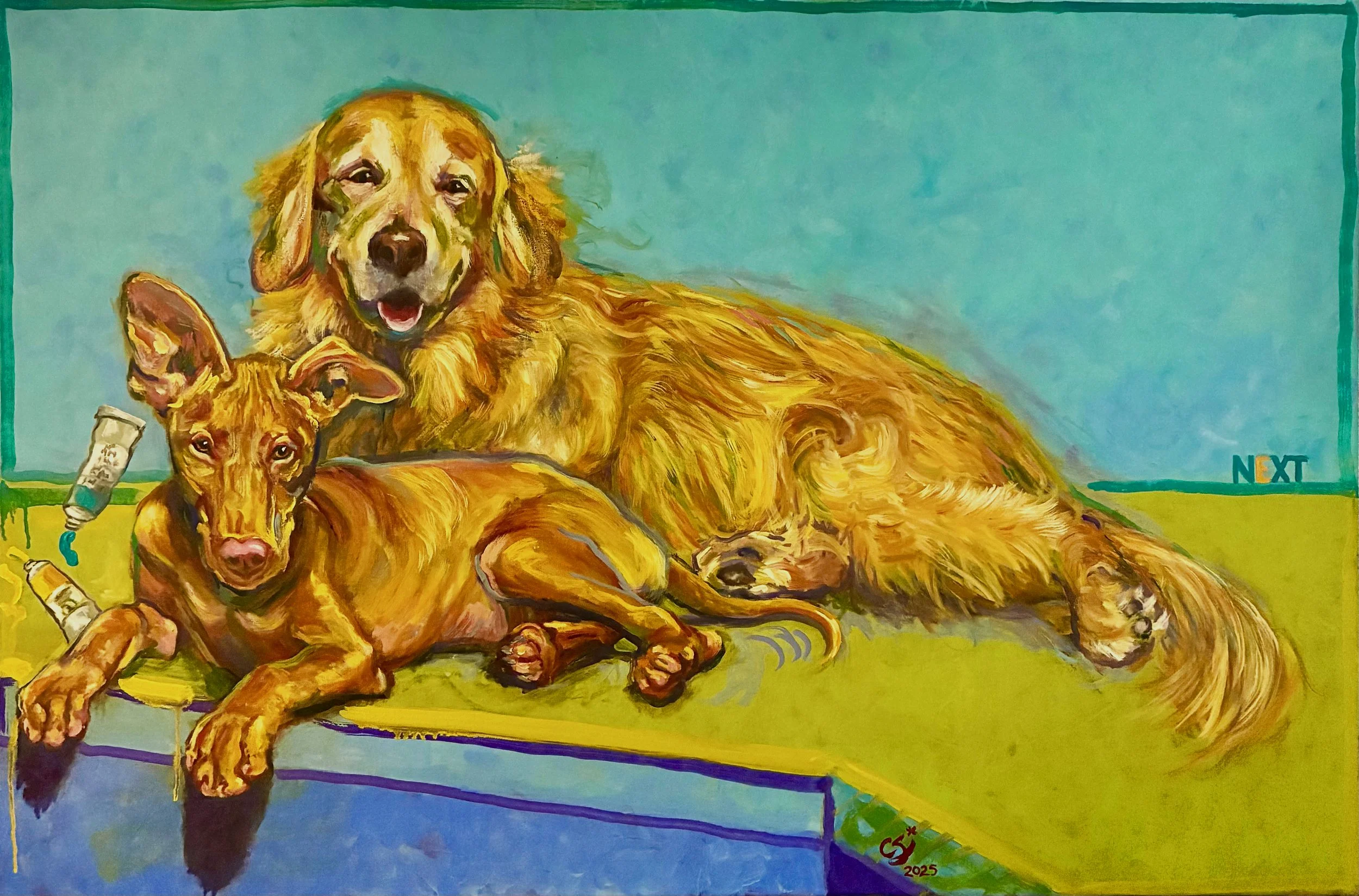
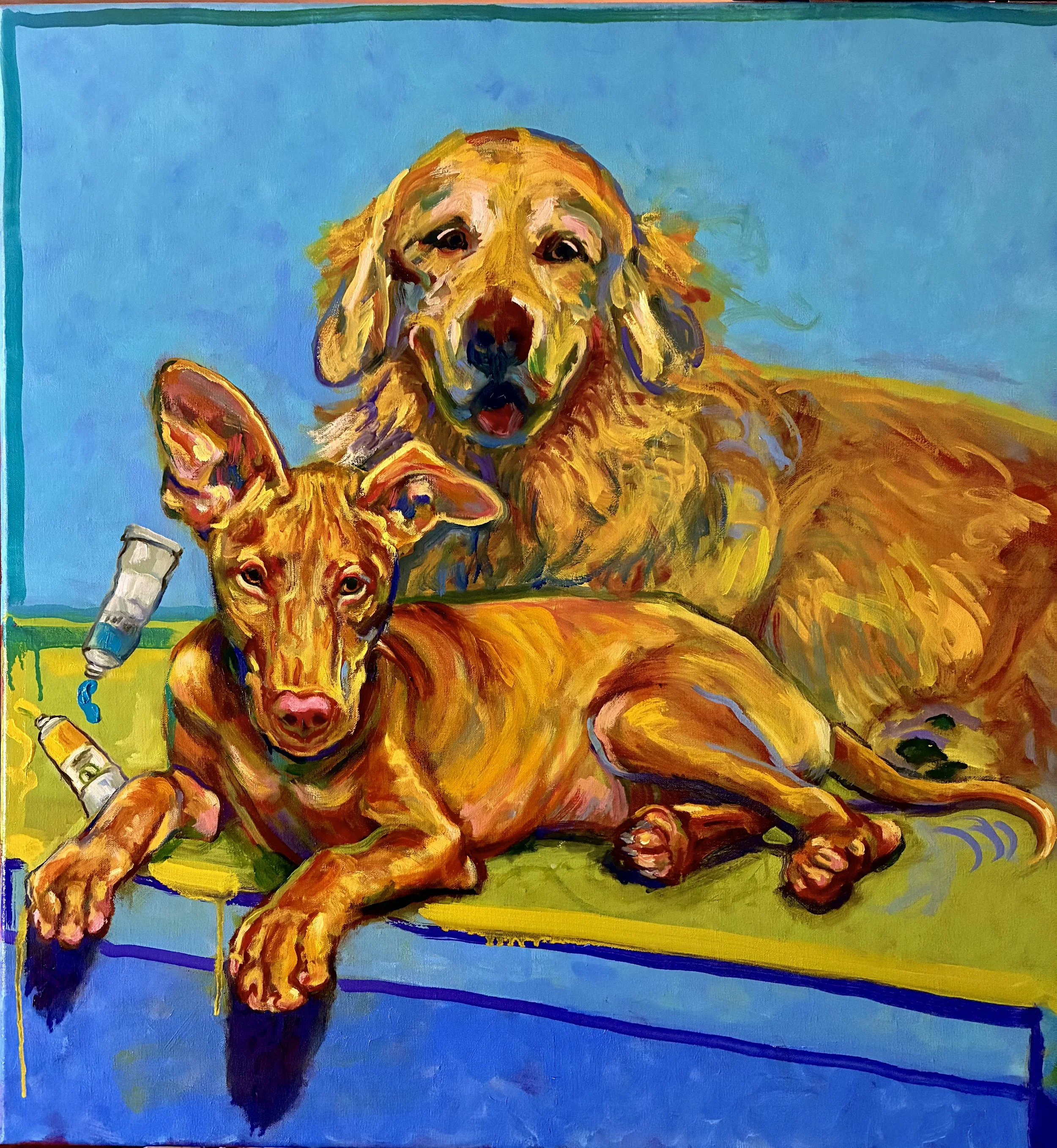
After time off for a couple other projects, making my way back to Riverside Boys. Still two or three days from completion, the painting has come together in my mind’s eye, so I am painting furiously to articulate the vision before its clarity fades.
The painting is a story of my two dogs: Poppy (elderly golden retriever) and Shai (pharaoh hound puppy). In the painting Shai is about six months old, and really beginning to express himself as the bad-younger-brother. Poppy, to everyone’s surprise, has become the patient-and-loving-guardian. They are composed as a spooned-together-band-of-brothers nested among abstracted blocks of color. The colorful shapes suggest the architecture from which they are derived, but they don’t represent the architecture … not in the way a photograph is representational.
My goal here may sound peculiar. Many times over the years people have commented that my portraits “look so real”, even “like a photograph”. These comments are generally meant as compliments, and I am honored to accept them as such. But lately I’ve been feeling unusually connected to process, probably because of the students. And focusing on the process has caused me to fall in love all over again. I don’t just love creating portraits — I love PAINTING! I truly love smearing color on things. Thus the squished tubes of paint and the 90’s style paint drips and lettering (which happened spontaneously late the other night).
… In the home stretch and working on Poppy today. Saved the best for last.
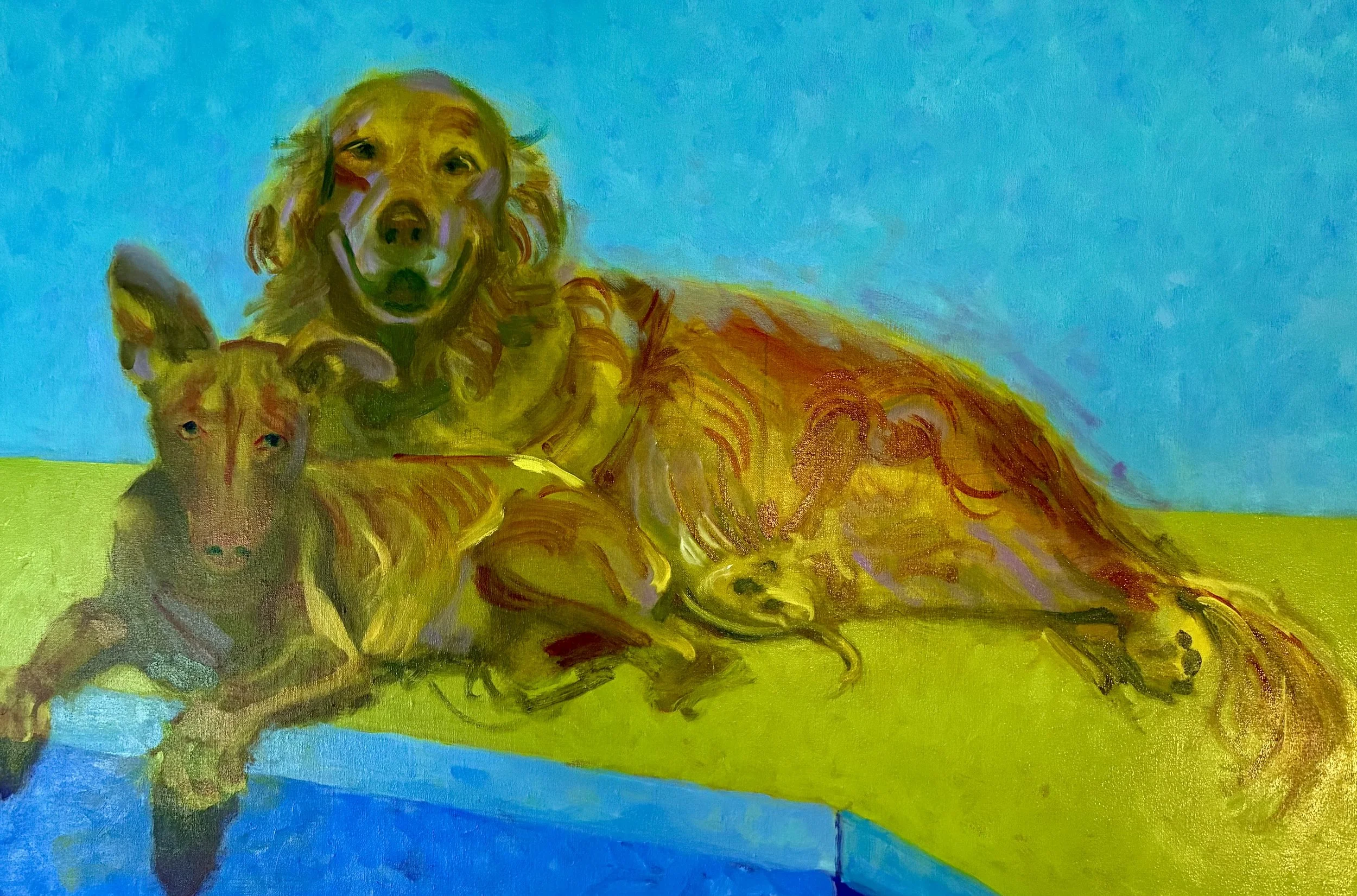
Have taken some students in the Jacksonville studio and as students will do, they are teaching me what I already know. One fundamental that is particularly difficult to learn is to let go of the underpainting layers. Students never want to lose the line or the sketch or the phase-alpha structure …. they lack faith that the fundamental architecture will be steadfast…. that the layers of construction, reassessing, course-correcting, rediscovery, and doubt … will ultimately lead to the place they wanted to go all along. They own time in this setting: only they can do this — build emotional energy layers as color and texture. But they are yet to understand that time can be owned in this way.
Riverside Boys was started some time ago, and now I’m back to it for the afternoon. Time to lose it and then find it again. Actually easier said than done. But here we go…
I honestly can’t remember a time in my life when I wasn’t drawn to metaphysics. As a child I can remember private conversations with my ‘secret doctor’, particularly during difficult family times. I would retreat to my hideout under the attic stairs and listen to (what I now know as) my inner voice. Now, as then, I’m gently guided to new ideas and methods for shaping my world. And much later I would understand that his process is essential for making art.
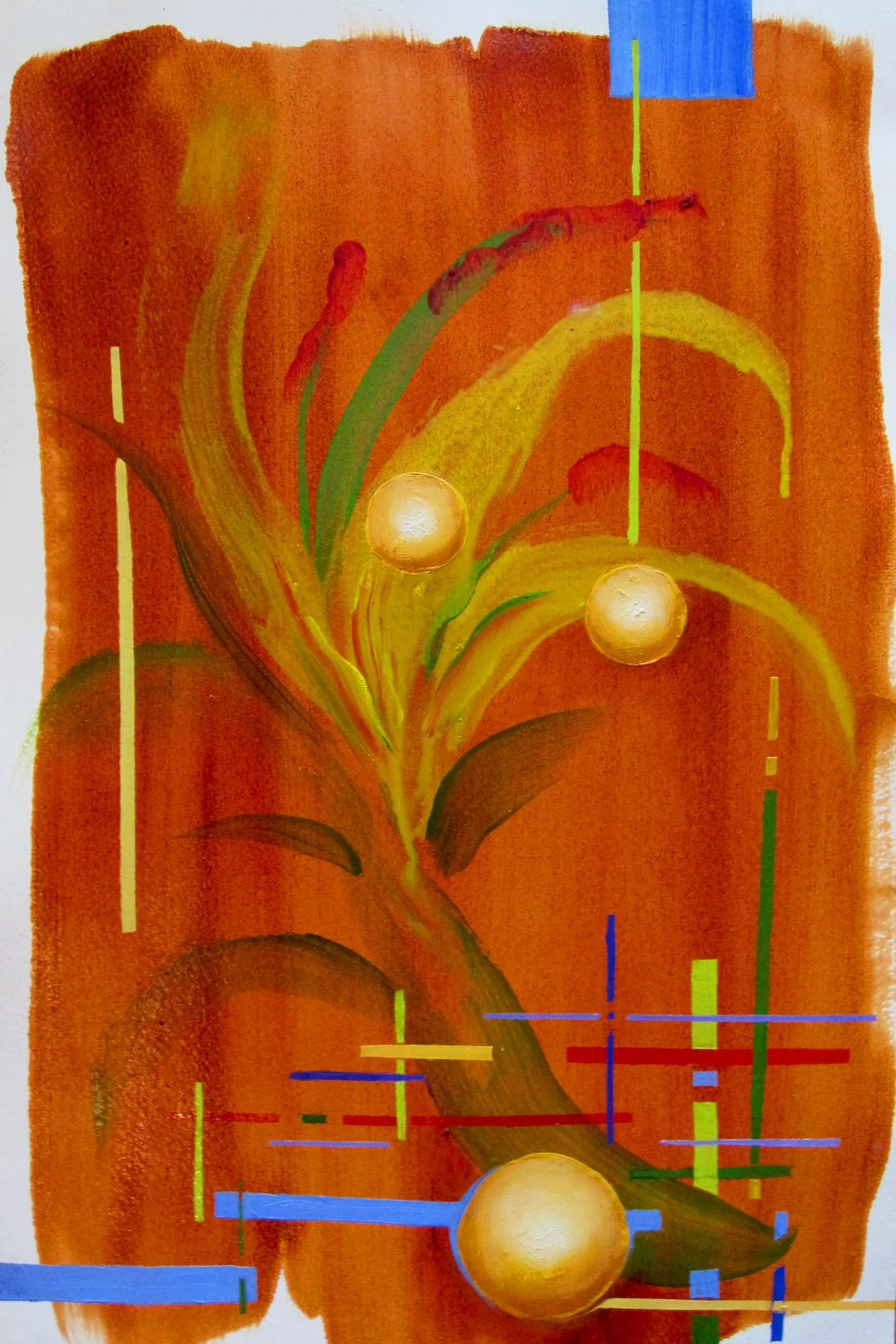
The series of Unseen Architecture paintings is an unending attempt to explore metaphysical principles through art. After decades of trying to reduce the multiple interwoven forces of time space which shape our layers of reality into a picture ….. really … A PICTURE …. well, life’s real mystery is why I keep trying … tilting at windmills.
Mysteriously, I do keep trying. Symbols of all kinds are incredibly content-rich bundles. Always building blocks of art, symbols hold worlds of meaning, now as much as ever. Emojis are especially powerful — a contemporary visual vocabulary which remains ever-relevant by moving at the speed at technology. Moreover, they are happy and accessible — exceedingly useful in communicating unfathomable concepts.
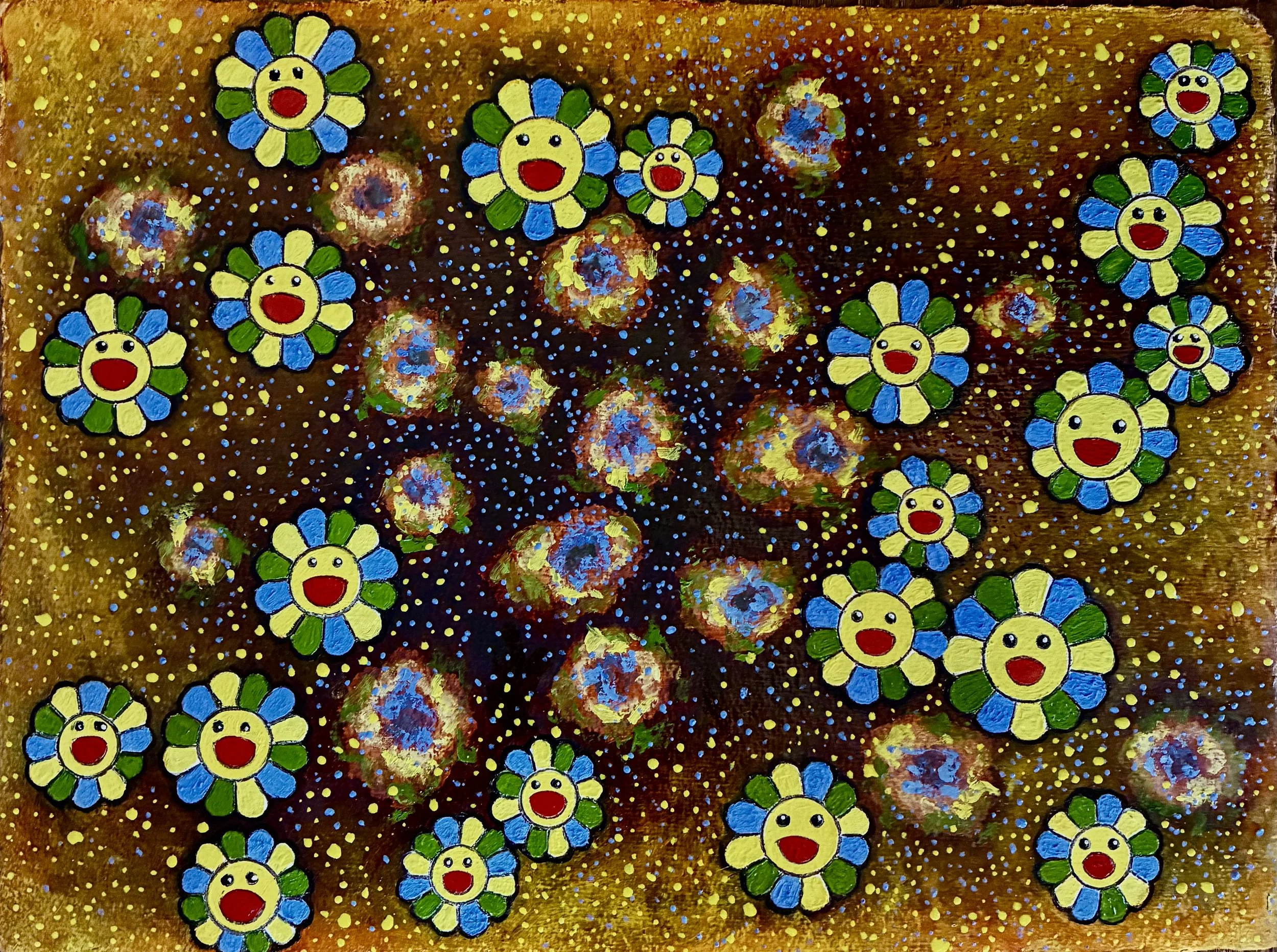
This little painting is another noisy metaphysical piece, using the only approach that feels right for our times — NOISY! Plato’s Garden represents the Allegory of the Cave from The Republic. The ‘forms’ in my version are Murakami’s smiling flowers; the ‘shadows’ float deeper inside the cave, floral but unformed. In Plato’s Garden the shadow flowers are drawn to the light outside the cave, like living plants to sunlight. Forever hopeful, my shadow flowers move into the light, clustering among the forms, and blooming in higher layers.
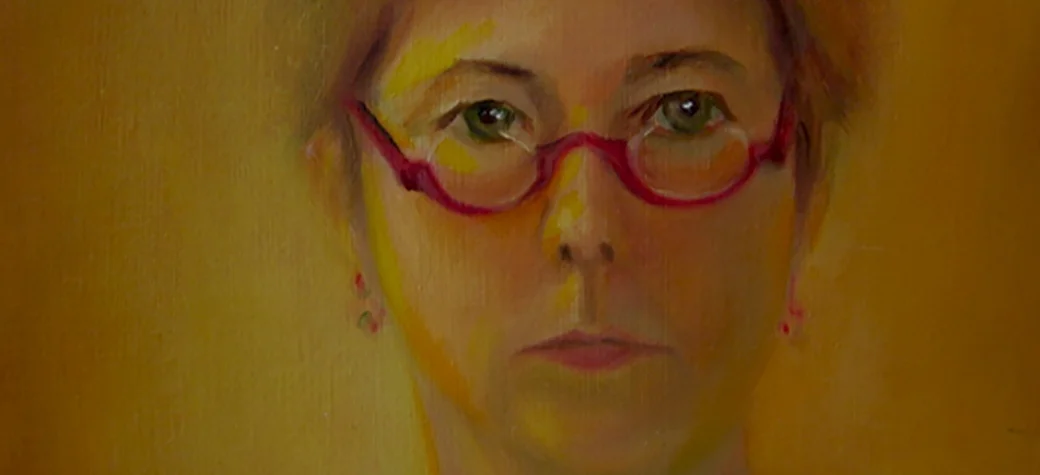
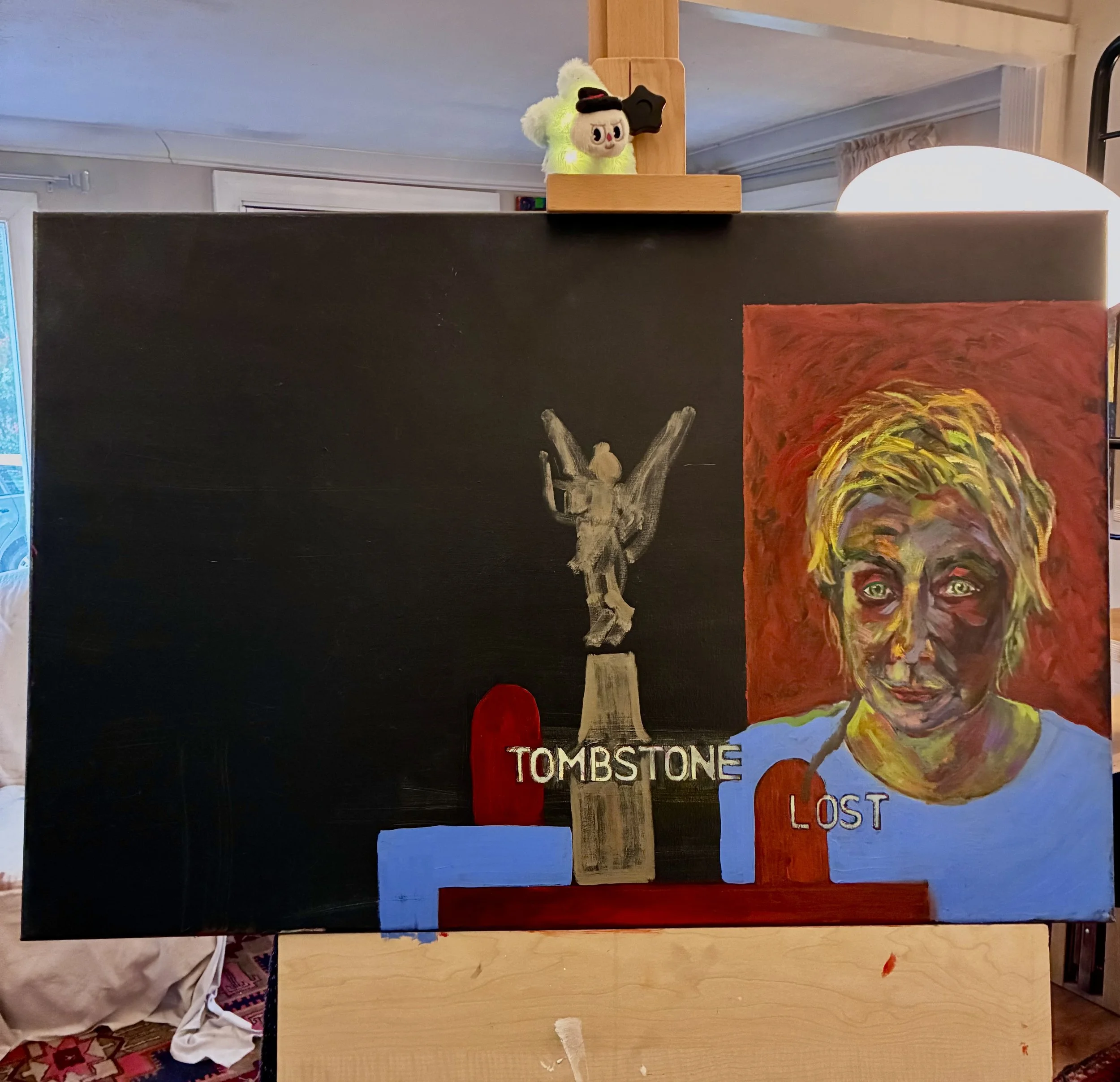
Moving forward with the Tombstone Lost project … now featuring a self portrait monster. As the idea evolved, I wanted to include an evil element — evil and also fun — a monster — like Godzilla. Well, recent eye lid surgery, while wonderful for my vision, also turned me into a scary creature for a week or so. Since there are no coincidences in art, Self Portrait as Monster found expression. Next … think I’ll work on the tombstones.
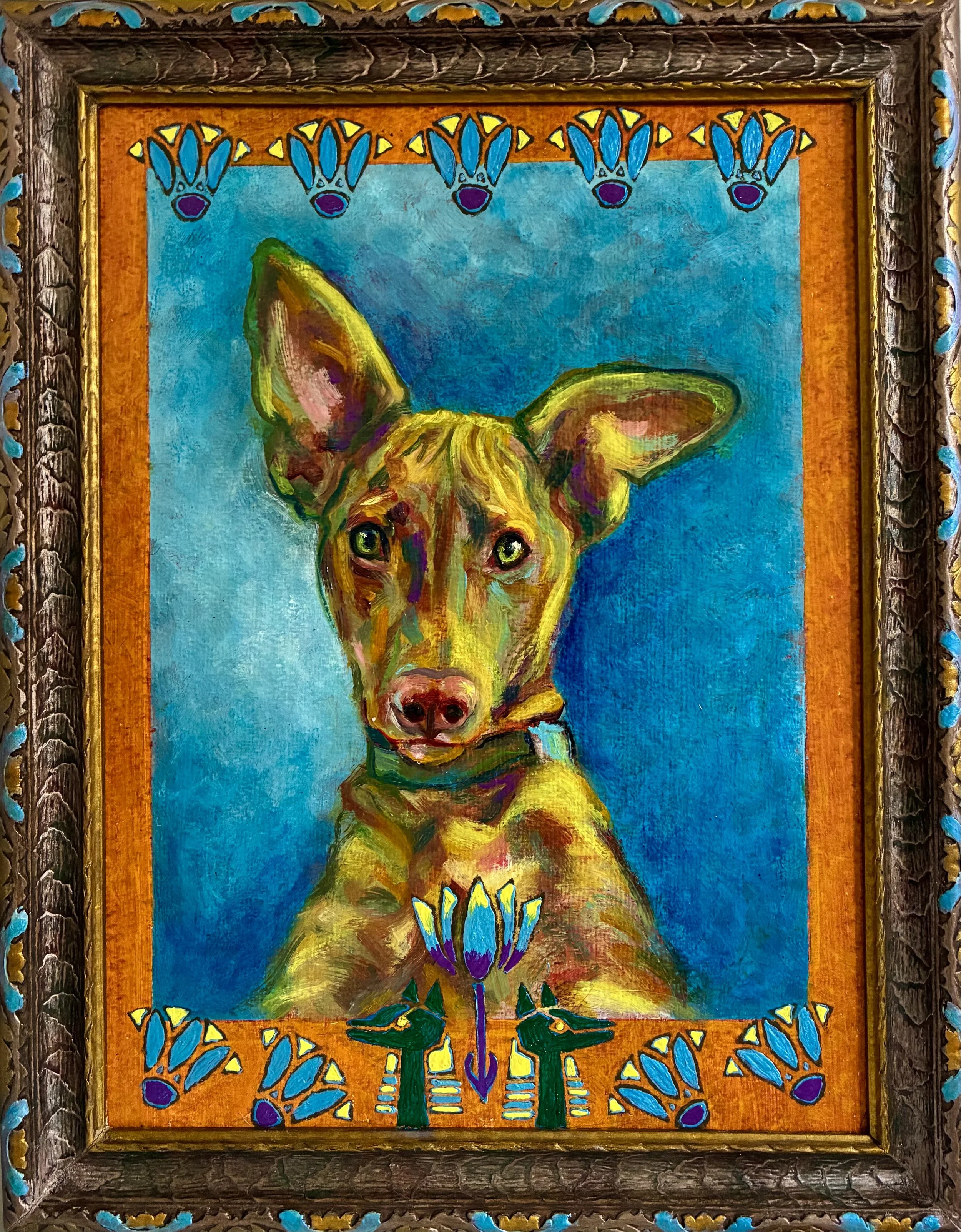
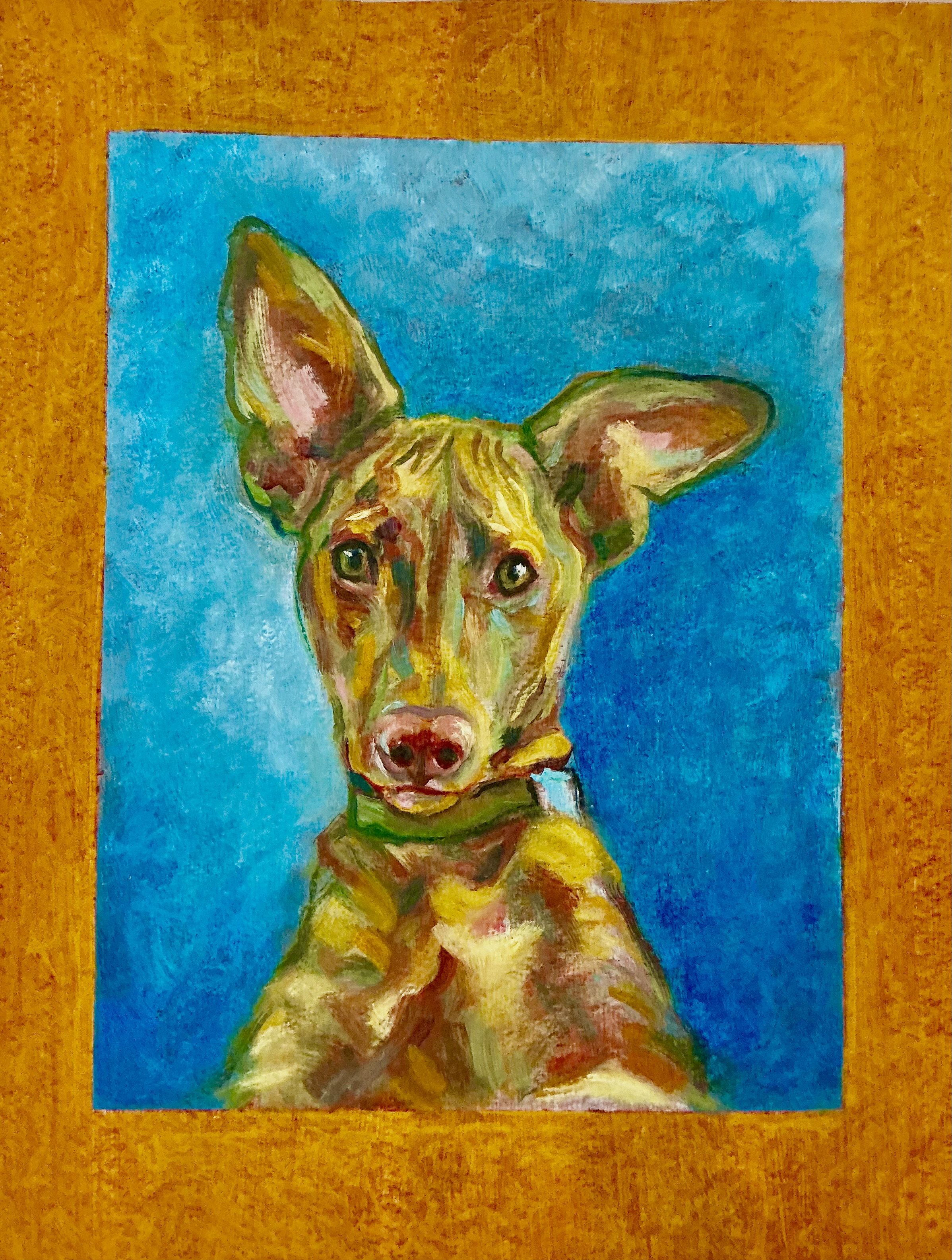
Finished portrait of Pharaoh Hound puppy Shai. I’ve been using symbolic elements a good bit lately, especially emojis. Egyptian hieroglyphics seemed a perfect fit for this picture.
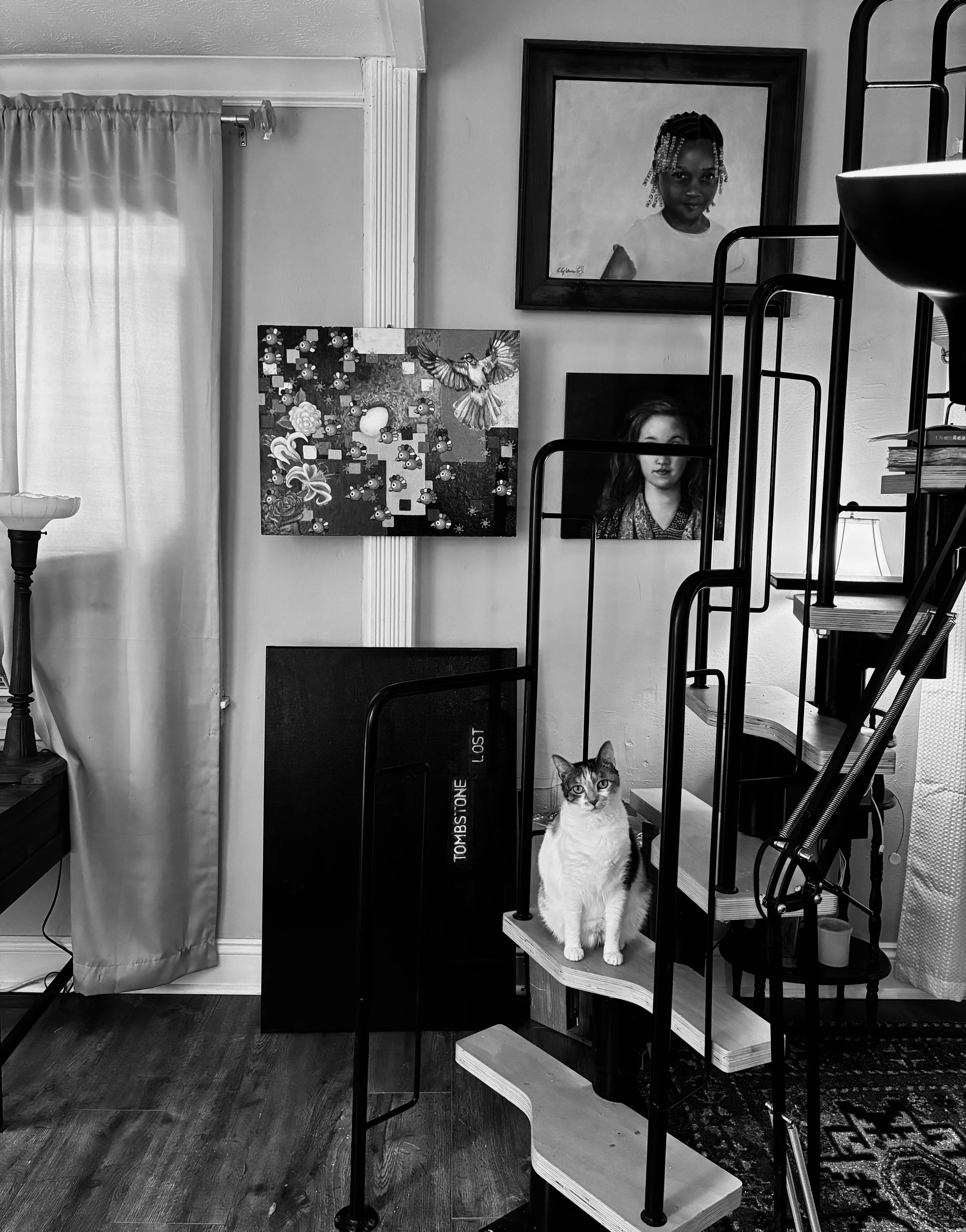
For literally years, here and there over time, I added elements to the painting now called The Noise. First on the canvass was a portrait. Eventually I painted over that for another portrait — with a floral tribute to John Singer Sargent called Camilla Lily Lily Rose. Then at some point the second portrait was covered, with the flowers remaining. Next came a mockingbird, egg and cosmic nest along with a new name, Mockingbird Lily Lily Rose. Some symbolic layers of color and building blocks were added. Emoji birds came along to dial up the volume, followed by counter-directional blue cyclones. Somewhere toward this last round of symbols I realized what I had been painting — autobiographical noise.
Feeling reasonably certain The Noise is finished, l started my next autobiographical graffiti today. This one is about a topic I know far too well — rejection and loss. Although the symbols envisioned for this picture are unique to my story, we all know the pain of loss. And if we are fortunate we’ve managed to see beauty in symbols of pain-remembered.
For now the painting is called Tombstone Lost. Since those actual words are rendered on the canvass, the title may stick. Guess we will see.
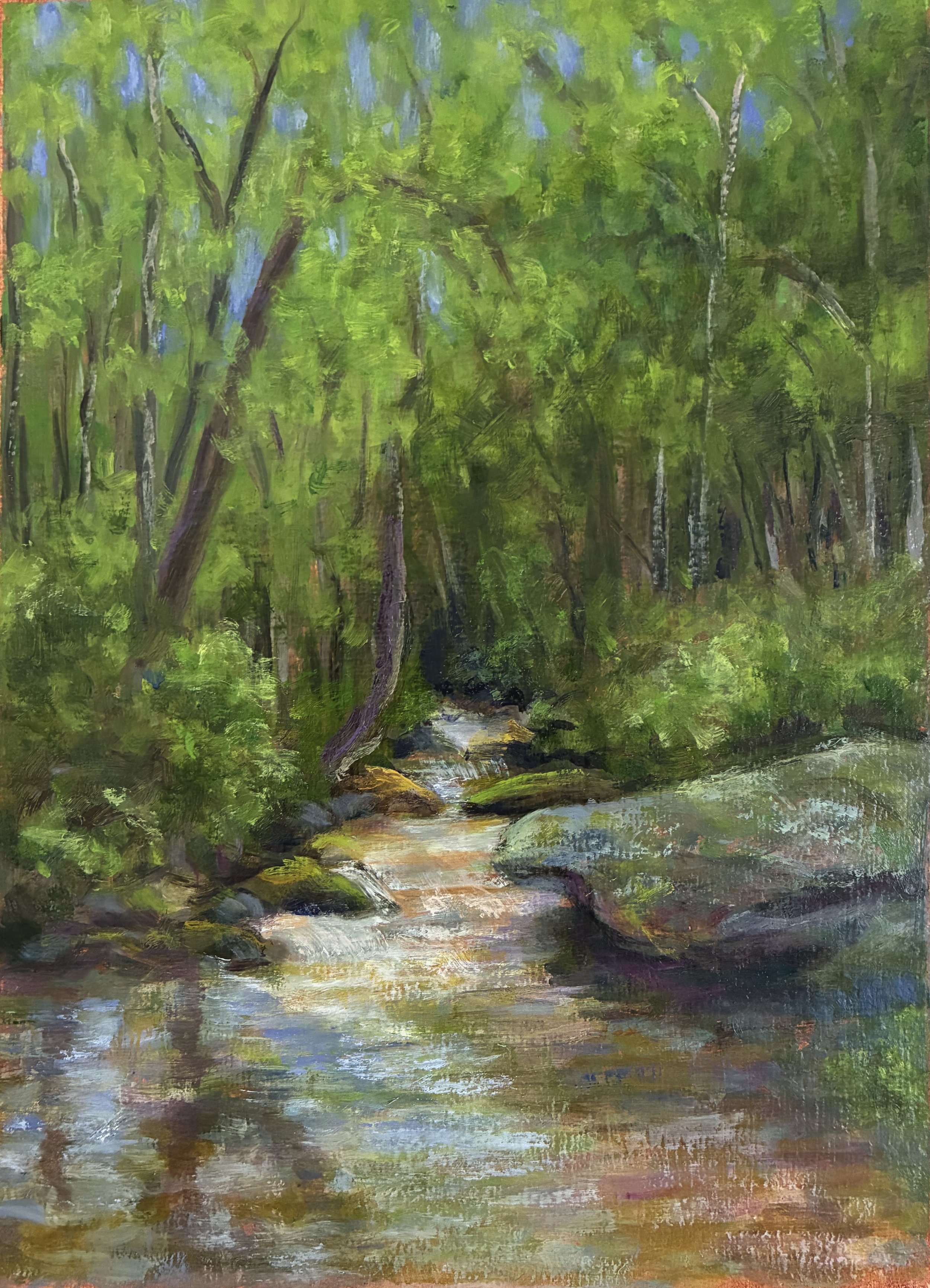
This is a prep sketch for a large NC mountain landscape; the sketch is oil on paper 10x14 inches, and was painted at the site, with finish work in the studio. The finished piece will have the perspective of someone seated on the large rock on the right.
Shai the Pharaoh Hound puppy at about four months, before both ears stood up.


Santa Knows heroes are chosen for both knowing great truths and giving great gifts to the world. In terms of knowledge, Albert Einstein is unmatched. He allowed us to understand the nature of reality on a new level, and his genius opened a portal to a new universe. Like great artists, great scientists stand on the shoulders of those who came before them. Astonishing advancements in science and technology today, benefiting us all, rest squarely on the shoulders of Einstein Santa.

Recent political realities have made me think a lot about good and evil. Is there an actual, universal, apolitical, areligious line is the sand? THE line. Item A is evil, and item B is on the other side of the line — on the good side of the boundary. My artist’s eye conjures up a fixed line in space, extending like a ribbon of highway for miles and miles. On one side is this creepy guy, angry and screaming across the border. On the other side …. a baby.
We all want that line the be clear and universal. It should be, right? For instance, it’s clear to see that murder is wrong. Yet when a CEO’s leadership deprives countless people of life and health, the conversation takes on a few more layers. And other recent news: one side says the debt ceiling is always good, the other side says it’s always bad, for years it’s been that way. Suddenly let’s all to switch sides to now-bad, now-good.
I just read a fantastic essay by David Brooks in today’s NYT. The Shock of Faith: It’s Nothing Like I Thought it Would Be. The way he moves through the material to explore his experiences of faith, and how they shaped his views really resonates. He makes a solid case for the existence of that line in the sand. There is actual good; there is actual evil; and it is possible to know the difference.
So I decided to accept his argument and see how how this foundation reshapes the Unseen Architecture of my universe. (It’s a chilly Sunday morning. Why not jump down the Unseen Architecture rabbit hole.)
So … for actual good, and actual evil to exist, there has to be a recognition of the difference. There has to be awareness. For me, and I concede this is a great leap, for me this awareness is consciousness — the unified field. And the soul is an individualized expression of the whole — a drop of water individualized from the ocean.
I confess to being one of those folks who believes in the soul — the individualized piece of consciousness that lives in all of us. Perhaps in all living creatures. Perhaps in all matter, living or otherwise.
Does all matter have consciousness? Why does the carbon molecule in me get to have a soul, but the carbon in a piece of paper does not? Perhaps the question is not ‘does all matter have consciousness’, because that frames the question in a way that restricts the consideration set. The real question is this: ‘what is the nature of matter, and what is the nature of consciousness’ — moving us beyond the limitations of a binary question. A possible truth: one does not contain or not contain the other — they are the same entity. Matter is Consciousness.
Again, from the artist’s eye, the universe is an oceanic field of awareness. It neither contains, nor is devoid of matter — consciousness and matter are the same thing. If matter composes the universe, then what about dark matter. Maybe this is just the yin and the yang of reality. In this imagining, dark matter would be the opposite of consciousness. And it would inhabit the other side of the line: consciousness and non-consciousness, matter and dark matter, good and evil.
In all of this imagining about the nature of reality, my artist’s eye always brings me back to shapes, specifically the line. The final delineation between yes and no, the object and the empty space. Over the years I’ve tried to express these ideas in layers of shapes. There is great joy in creating art to express the ordering principle of my world view, a visual demonstration that the world makes sense. Even trying to wrap all the mysteries up in a pretty picture completes me, but probably ONLY me. Given reactions from viewers over time, my attempts are falling short. As one friend put it, “I think I understand what you are saying, but when I look at this, what I see is plaid.”

The Santa myth has always delighted me. But it wasn’t the jolly-old-guy-with-presents-for-all part that intrigued me the most - it was his omniscience. Santa Knows. And it is both the giving and the knowing that have inspired my choice of Santa Knows heroes. Steve Jobs died in October 2011. Knowing what an Apple fan I am, friends immediately said, “I know who your Santa Knows will be this year.”

Third in the group is a completely made up Santa. Perhaps surprisingly, that’s not an easy thing to do. As a classically trained painter, I render a subject from direct observation. In other words, I’m trained to paint what I see. This fellow was created to express kindness and peace. So I went deep inside my imagination to find a face to convey that. Curiously, the subject stayed within the limits of the traditional Santa stereotype - an older, white male. Conformity is not necessarily my approach. But there could be another force at play: my father died decades ago, and I think those might be his eyes.

This was Santa Knows year 2. My (departed) friend Ken Penuel modeled for what we thought was a funny idea — a creepy Santa. Actually I still think it’s funny but a lot of people were offended. At the time I was bothered by that. But now I’m like ‘lighten up you grumpy people!’ One of the great things about getting older: perspective.

For almost two decades I’ve painted a Santa to share with friends at Christmas … not every year, but probably around fifteen total. I do have a new one this year.
2006 marked the beginning of a Christmas tradition for Studio C Shute — Santa Knows. I’d been working in the DC market for nearly three years, and wanted to send clients an artistic card for the holiday. After a disappointing search among commercial products, I did what artists do: I made my own. The card needed a theme, something stretching the boundaries of tradition. And it needed to feature portraits. The jolly old man’s omniscience won the day, and Santa Knows was born. A friend modeled for the first card, rendered in ink and oil paint on paper. Subsequent Santas were more elaborate, but for me this first one captures a Knowing Santa as well as any of the later subjects.
